Coasting down the gentle canal waters, surrounded by brick buildings and the medieval walls, it didn’t seem like a place that should actually exist outside a fairy tale or a movie set. Once the economic hub of the Low Countries, the town of Bruges, Belgium, is today one of the most appealing small cities in Europe.
Just a one-hour train ride from Brussels, the capital of the European Union, Bruges stands seemingly forgotten by time. The Europeans haven’t forgotten it, though, naming it the European Capital of Culture in 2002.
When I was there, it was after a visit to Brussels, where the old market square and Mannekin Pis were worthwhile, but I didn't have a chance to fully explore the city. With only two days before I had to fly home, I hoped Bruges wouldn’t disappoint.
It didn’t.
My first night there was a blur of train station, taxi ride through dark streets and check-in at the Hotel Adornes, located in the old town.
 In the morning, I awoke to the splendor that is Bruges. An overcast sky threatened rain, but the canal outside my window gently lapped at the piers of a centuries-old bridge and ran past brick buildings as it met up with the other small waterways that add to the ambiance of the city.
The hotel offered free bicycles, and my family and I wanted to make use of them before any rain came. We went down to what I thought of as a stable, and selected four of the 20-odd two-wheelers there. Childishly delighted with the bells attached to the handlebars, we rumbled over cobblestones toward a series of windmills knowing that all cars yield the right-of-way to bicycles in Bruges.
Along the outer canal of the old town, several old windmills stand as examples of one of Belgium’s quintessential sights. None were open at the time, though it looked like they were sometimes available for tours. I would have liked to see the wooden wheels and pegs that made up the older windmill gears, but I had to settle for the views of the exteriors and, inexplicably, only manage to take one (poor) photograph.
Leaving the windmills, we rode over a dirt path that circles the old town. In the canal to the left, low-slung barges passed each other under stone-and-brick bridges. Several of the larger roads spanning the canal had fortified gatehouses erected when Bruges was entering its golden age, between the 12th and 15th centuries.
 The curved sides and stout construction of one of them indicated its being designed for mortal struggle, but with the host of swans lazing in the canal beneath it and the occasional car passing through its permanently open gate and portcullis, it’s hard to imagine a time when enemy armies might have threatened the town, even though its port was used by German U-boats as recently as the First World War.
Looking back to the town, building after idyllic building passed by, separated from us by the street and fields of flowers. The citizens of Bruges are surrounded by a rare beauty, and they maintain it well.
 Further on, we came to Lovers’ Lake, one of the more pristine areas I have ever seen in any city. The natural beauty is no more impressive than Hyde Park in London or some of the islands in Paris, but when the distinctive architecture and a few swans are thrown in, it’s hard to rival.
As the capital of Flanders, Bruges embodied many of the fine arts during and just after the Renaissance. Many canvases from the Dutch Old Masters are on display in the city’s various museums, but with limited time, we opted to see one of the original fine arts still practiced today.
Following directions in our guide book, we weaved through several small streets before coming to a lace museum. We wandered through it rather quickly, stopping to view some of the most ornate garments and tablecloths I have ever seen, then walked into the meeting room.
 A low hum of click-clicking greeted my ears as I stepped through the door to see about 30 elderly women tossing wooden spools of thread over each other to weave intricate designs. The less-complicated patterns required the workers to juggle between 10 and 30 spools, while some of the more complex designs necessitated far more.
I’m usually one of the first to roll my eyes at the obvious tourist-trap “crafts” that any 12-year-old can make in art class, and this was nothing of the sort. It was abundantly clear that the women, chatting to each other in Flemish, French and English as they worked, had spent years honing their skills. Without a burning need for a doily, I couldn’t rationalize spending the money that the pieces are definitely worth to buy one, but just watched them work.
 After an excellent lunch at The Flemish Pot (a future post), we grabbed a ride on one of the canal boats with a group of Mexicans proudly supporting their team in the World Cup, which was being played in Germany at the time.
Floating through the city’s waterways as the guide explained what we were seeing in no less than four languages, we passed under low bridges and got a better understanding of some of the historic buildings dotting the city, including the belfry that stands on the south side of the market square and has 47 bells still played by a full-time employee.
After the boat ride, we got back on our bikes and sped toward the town square for some chocolates from Dumon before the shop closed, and a stop at the town square, which has the belfry and the city hall. It was fairly crowded with a mix of tourists, buses, horse-drawn carriages and people out walking their dogs.
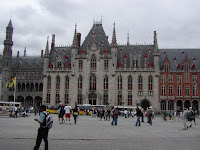 We had dinner at a local pub with delicious food and beer that seemed to evidence the Belgians’ assertion that their beer is better than Germany’s, and then it was time for a nighttime walk through the town, which had become surprisingly quiet. The water reflected the subtle lights and our footsteps echoed in the narrow alleys as we whiled away the last hours of our trip.
Taking the taxi to the train station that would take us to Brussels and a flight home the next morning, we passed through the city as it was waking up. The sun rose higher above canals and buildings that can only be described as quaint. At that moment, I felt like Bruges was begging me to stay. I had to settle for promising myself a return trip at some point.


 Paris Throws a Party


