Friday, August 22, 2008

The Taste of Travel: Crepes in Paris

At the intersection of Rue Bonaparte and Boulevard Saint-Germain in Paris is one of the most famous cafes in the city - Les Deux Magots. It also happens to be the site of my favorite crepe stand.

When closed, the stand looks like an oversized transformer housing, its green walls giving no clue as to what’s inside. When it opens, however, the walls become shelves and sun shades, and the aroma of cooking crepes mingles with the scent of popcorn to announce its presence.

The first thing I ever ate in Paris was a crepe from that particular stand after a Eurostar ride from London. I remember being tired and hungry on the way to see Notre Dame on the nearby Ile de la Cité and stopping there.

These days, many places hawking crepes, especially to tourists, are just nuking a few they pulled out of a box that had recently been in the local grocery store. This man working this stand, however, made them fresh.

I chose a Nutella crepe, and the friendly Parisian went to work. First, he poured a pancake-sized puddle of batter on a crepe pan, a flat, black surface heated electrically, and then spread it around with a wooden tool as thin as a ruler with a dowel serving as a handle. After only a few seconds, he flipped it over, and topped it with Nutella, a chocolaty hazelnut spread.

By the time the Nutella was spread, the crepe was done cooking, and he rolled it up and wrapped it in wax paper before handing it to me.

I took my first bite, and it was fantastic. The golden brown hue of the crepe evidenced its perfect cooking, and the warm Nutella oozed out as I ate it. It was almost too sweet, as the crepe was like a thin pancake with too much sugar and the Nutella was like a Hershey bar, but it was still great.

When I’d finished it, my mouth was coated with Nutella, and I needed something to drink. Water just wasn’t going to cut it, so I went to buy one of the sodas the man was selling…and he gave it to me.

A free soda might not sound like a big deal, but it was my first time in France, and I was expecting someone to be rude. Coupled with the fact that sodas are ridiculously expensive over there (I want to say €3 for a can is about average in the touristy areas), I couldn’t believe it.

On that first trip, all myths of the French being rude were debunked as far as I was concerned. The people were friendly to a fault, and being in such a perfect setting, the French capital quickly became my favorite city in the world.

Two years later, I was fortunate enough to return to Paris, and I made sure to pick up another crepe across the street from Les Deux Magots. I found other places, especially in the Rue Cler area, where I could get a crepe made in front of me, but the ones made in the green stand at the intersection of the Boulevard Saint-Germain and Rue Bonaparte are still the best.

Sunday, August 17, 2008

The Kindness of Strangers: An Indian Couple from Louisiana

It was almost midnight, I had been in motion for 22 hours, I was alone in a foreign land, and the only word I was reasonably certain I could pronounce in the local language was “salad.” Oh, and if I ate salad, I was almost sure to get the dreaded “Delhi Belly.”

I stood at an anonymous baggage carousel in Mumbai’s Chhatrapati Shivaji airport (I can’t pronounce it either) hoping Delta hadn’t lost my bags in New York after a day that began at 5:30 in the morning in Sacramento, had interminable stops in D.C. and New York and had just culminated in a 14½-hour flight to the far side of the world.

A unique smell filtered in from the muggy air outside. It had hints of spice, humanity and exhaust fumes. As I saw my battered suitcase slide onto the conveyor belt, I decided it wasn’t an altogether unpleasant smell.

Once I picked up my bag, I headed toward the family that represented my lifeline. Dossu and Shitakme, the middle-aged Indian couple I had been sitting beside for the past half-day would see me to the Hotel Suba Palace, 45 minutes away.

Eight-hour conversations on 777s are a great way to either make friends or annoying enemies, and these two were the former. Emigrating to the U.S. about the time my parents were starting to date, the Indian dentist and his wife were a few weeks away from getting U.S. citizenship, and were returning to their homeland to attend a wedding. After giving me countless hints on how to keep from getting scammed by opportunistic locals, they asked where my hotel was. Once they found it was in Colaba and not far from their own, they offered me a ride with their friends, who were meeting them at the airport.

As I dragged my suitcase to them and their family, I was warmly greeted with a friendliness that would become happily familiar on this trip. I asked them to wait while I changed some of my dollars for rupees, and Shitakme handed me a 100-rupee note and said that I wouldn’t need any more before I got to my hotel. When I tried to give her the equivalent in American currency, she told me that if I offered her money again, she would slap me in my face.

I’m not one to argue with people in their own country, so I followed them through a security checkpoint and then through the door.

My first sight of India from the ground involved a guard with the curious habit of resting his chin on the muzzle of his rifle in front of a fence crowded with around 250 cab drivers, idlers and people meeting family and friends.

I switched my cell phone on to call home and let the folks know I was safely on the ground, and before I could enter the number, Shitakme thrust her phone in my direction and told me to call on it, since it would be cheaper. I didn’t dare offer her any cash for the call.

Since their car was full, I would ride with their luggage and a second driver. She gave him her phone and told me to call home again when I reached my hotel, and she’d get her phone back later. I thanked her and got into a red compact vaguely reminiscent of a Civic.

The most obvious thing was that there were people everywhere. They sat in dark corners, cooked over open fires on the sidewalk, stood in the cones of light emanating from streetlights, carried goods on their heads, slept on the street beside the Porsche dealership, and drove around in everything from autorickshaws to Bentleys.

We drove on the left side of the road, oblivious to red lights and lane markers someone had painted on the ground in vain. In a series of near-death encounters that would prove to be the norm when traveling by car in India, we skirted past trucks and bullock carts closer than I would ever have been comfortable parking in the United States.

We neared Colaba, and the driver, who patiently answered my myriad questions throughout the ride, asked me for the address to the hotel. I winced and read the only address the hotel has: “Near Gateway of India, Apollo Bunder, Bombay – 400 039.” For me, an address that began with the word “near” was frightening and archaic.

Apparently, it’s all good. Everyone knows where the Gateway of India is, and my driver simply drove near it, then asked one of the ubiquitous people sitting on the street for directions. He pointed and said something I couldn’t even guess at, and we drove another few minutes.

After one more stop for directions – apparently a normal way to locate something – I found myself staring at the familiar image I had seen on the Internet. I called home, grabbed my bag and thanked my driver, asking him to thank Shitakme and Dossu for their kindness once again.

He drove away as I approached the uniformed doorman, who greeted me with a grin and a hearty “Namaste” before leading me up some marble stairs to the registration counter.

I signed in on one of the last pages of a registry that looked like it had been around since India was still a British colony, then rode up the miniature elevator to my room. When I opened the door, I wasn’t sure what I would find, hoping it wasn’t a bait-and-switch differing greatly from the photos of the rooms I had seen on the Internet.

It might have been any hotel in America. Two beds and a chair that folded into a third bed were spaced out in the room, which was complete with a fully functional bathroom and TV. The lights, heater and fan were all controlled by a remote. I smiled and realized I had been uneasy and a little nervous for nothing.

It was my first time traveling alone to a foreign country (my friends arrived 24 hours later). It was my first third-world destination, and it turned out to be a great deal easier to handle than some experiences I’ve had in America.

Of course, I have Dossu and Shitakme to thank in large part for that.

Monday, August 11, 2008

Lake Tahoe's Emerald Bay and Vikingsholm

My fascination with international travel sometimes blinds me to the superb natural beauty just a short drive from my own house. I dream of hiking in the Swiss Alps and revisiting Austria’s Lake District, but I often forget that some of the world’s best places are so close. Last week, I decided it was time to go to Lake Tahoe, and visit the part I feel is the most beautiful, Emerald Bay.

While Tahoe has a host of lodgings, from the cheap to the quaint to the luxurious, this trip was all about camping. My family and I stayed at the D.L. Bliss campground, which is just a short drive from Emerald Bay, and walking distance to the lake in general.

We arrived to the news that bears were frequenting the campground, and I was ecstatic. I’ve only seen one bear in the wild, and I wanted to get a good shot with my new camera. Eating lunch at the Old Tahoe Café in Homewood a bit later, we saw pictures on the wall of when a bear had stopped by in April, sneaked in the back door just after the lunch rush and made himself at home. We drove back to camp to set up, and I kept my eyes open for one.

Reluctantly leaving the possibility of seeing a bear, we went to Emerald Bay. Standing at the overlook above Vikingsholm, I gazed out across the long, narrow inlet with Fanette Island rising prominently out of the deep blue water. Sailboats, a paddle-wheeler and a bevy of kayaks and powerboats cruised and darted throughout it, and the tree-covered mountains rose above the shores.

As darkness fell, we drove to the next overlook, a short jaunt down Highway 89. Having gotten our fill of Emerald Bay for the day, we headed to Southshore to eat at a brewpub and saw the sunset from the nearby beach.

Back at camp, sitting around the fire an hour later, I had my camera ready to get a great shot of the bear I was hoping would be attracted by the dogs’ food. I grew tired, and decided the bear would have to wait for another day. I stepped out onto the campground’s road and looked up to see the Milky Way.

Staring at the stars is one of my favorite pastimes when camping, and though I’m no astronomer, I like locating the major constellations while I wait to see a falling star or a satellite passing by. After two falling stars and one satellite, my neck was aching from staring up, and I was really, really tired.

The next morning, we all rented kayaks and paddled around Meeks Bay, then went back to Emerald Bay to do something I have always wanted to, but haven’t in the 25 years I’ve lived so close.

On the shore of Emerald Bay at the shortest distance to Fanette Island sits a structure that looks like it was transplanted from the colder regions of Europe, and that was exactly the idea when Lora J. Knight had the house built in 1929.

Knight was a wealthy woman who seems to have been as obsessed with travel as I am. She had traveled to many foreign countries, including those in Scandinavia. Emerald Bay reminded her of the fjords in those countries, and she was determined to recreate the architecture and style of the buildings there and live in the result in California. To make sure she and her nephew, the architect, got it right, they traveled back to Scandinavia and took photographs of a multitude of buildings.

The foundation was laid in 1928, but did not get any further until 1929, when a construction crew numbering from as little as 25 at times to as many as 200 at others finished the house and the small 16’X16’ tea house on Fanette Island which can still be visited by boat today. She called her new home Vikingsholm.

The hike down to Vikingsholm follows a winding path that isn’t quite a road. I was there on a Saturday, and it was very crowded, with parking at a premium. After finally finding a spot, I followed the path down the mountain. Evergreens rose on both sides, and the wildlife scampered across the ground and flitted from tree to tree.


As I passed a family carrying lunch down to the shore, I noticed everyone was speaking French. It turned out that they were from Paris and were there on vacation. It was a great reminder that Lake Tahoe remains one of California’s premier attractions.


When I reached the base of the mountain, I walked a short distance along a winding path through the trees to come to the stone and wood Vikingsholm. Though I had seen the front side from the overlook several times over the years, I never knew that the home was so big, set up in castle fashion with an interior courtyard, servants quarters and a garage housing a 1936 Dodge.

It cost a paltry $5 to get in and take the tour, and it was well worth it. The guides explained the sights and furniture, some of which is original and some of which was reproduced during the 1920s to mimic Scandinavian designs.

One thing I was truly amazed at was the scope of Knight’s generosity. She was fantastically wealthy, but apparently didn’t let it get to her head at all. Though it was the height of the Great Depression, Knight kept a full household staff – in duplicate so they could have days off. She gave her workers paid holidays and even financed their downtime in the Tahoe Tavern in Tahoe City (which has since burned down). She set up some of her servants’ children with college funds and allowed their families to visit them at her home. She even willed them all $1,000 for each year of service that they received when she died in 1945.

The generosity evident at Vikingsholm isn’t just limited to Knight. The second long-term owner was a man named Harvey West. He agreed to donate half of the appraised value of the site to the state if the state would pay the other half. The state readily agreed, and took ownership in 1953 for a bargain.

As I walked through the carved wood door with its iron strap hinges so reminiscent of fairy tales, I appreciated what an effort went into building the house. The materials all came from nearby, and it turned out that my great-grandfather worked at the mill where much of the wood came from at the time the house was built. I ran my fingers along a portion of the wall and found myself wondering if I could be touching the same piece of wood as one of my ancestors whom I never had the fortune of meeting.

The décor inside was authentic to Scandinavian designs, and it was a perfect way to get a sense of what Scandinavia is really like since going there doesn’t exactly fit into my current budget and plans.

Once I was done touring the inside, I stepped into the courtyard and shook my head in wonder at the sod roofs on some of the buildings. They replicate a Scandinavian style, and used to sprout wildflowers, though they no longer do, at least until they are restored. Above the roofs rose the ever-present mountain views Tahoe is fortunate to have. Rocky peaks reached skyward a couple thousand feet above me, and I could imagine I was actually in one of the fjords Lora Knight was reminded of when she envisioned Vikingsholm.

When it was time to go home, I couldn’t believe that it took me 25 years and so many trips to Lake Tahoe that I’ve honestly lost count before I visited Vikingsholm. Not only are the stories of Lora Knight and Harvey West inspiring, but the serenity of the natural surroundings is second to none. And, speaking of nature, I never did see that bear, though I did get to see a great sunset when I wandered from the camp in search of one of the beasts.

Saturday, August 2, 2008

Travel Tips: GPS Navigation

“Calculating route. When possible, make a legal U-turn,” said the recorded female voice. I dutifully obeyed, glancing over at my friend, knowing I had just made a wrong turn, but relieved that it would take less than a minute off the trip.

One of the most useful travel innovations in recent years has been the near-perfection of handheld GPS units at affordable prices. I’m no expert, but I predict that a few marriages will be saved by them.

The best thing the myriad GPS units offer is confidence. Knowing that I can just use the touch-screen to enter an address and have my route automatically planned takes a lot of the headaches out of traveling.

Voice prompts are given well in advance of the necessary maneuvers, and a highlighted line is superimposed over a detailed map. If you make a wrong turn, you will be rerouted and sent on your way.

Gone are the arguments where a map is pressed against the inside of a windshield and angry hands trace improbable routes. Oh, and there’s no more folding the maps back up…

Another nice feature maps simply don’t have is points of interest (POIs). Most devices offer a large selection of POIs, which can be hotels, restaurants, sports and concert venues, theaters, airports and tourist attractions, to name a few. Search functions allow you to type in individual names or categories, or simply search from a list of nearby places. Problems arise when the maps are outdated and businesses move or close, but updating them is simple.

The two units in the picture, a Magellan Maestro and a Garmin nüvi 370, both work by tapping into the global positioning satellites and using coordinates to determine their positions on preloaded maps. As the devices are moved, their positions are updated just a few seconds behind real time and routes adjusted accordingly.

Be they Garmins, TomToms, Magellans or another brand, the portable GPS navigators have several things going for them.

1. They are not mounted in vehicles. The navigation systems most car companies offer are permanent fixtures in the dash, and cannot be taken out for use on foot or even transferred to another vehicle.

2. They are very affordable. The amount of perks will dictate the cost, but car-mounted models run in the thousands of dollars as options. Both the ones pictured cost less than $400 each.

3. They will always get you where you need to go. It may not be the best route, but it will work.

4. If you run into traffic or a road closure, you can just take the next exit, and the route will be updated.

5. No subscription is necessary. As long as the battery is charged and the satellites are orbiting overhead, it will work.

As with most technologies, there are also downfalls.

1. Not everywhere is mapped. Taking these off roads causes problems. If you have a paper map with GPS coordinates on it, you can still use the GPS units to get coordinates and then figure out your location, but you may not be able to use them to map a route for you. There are units made specifically for hiking and off-roading, however.

2. Satellite acquisition can sometimes be spotty. In narrow alleyways between tall buildings, such as some spots in San Francisco, the antenna may not be able to locate satellites. Moving to a more open area will generally remedy the problem. I still recommend taking maps to unfamiliar places just in case reception is lost, the battery dies or you drop it and break it.

3. The routes are not always ideal. In playing with the two pictured units, I found that they tend to favor certain surface streets when “fastest route” is selected that are not, in fact, very fast. Selecting “most use of freeways” fixes that issue, but can also cause you to travel farther than necessary. This is a minor drawback that can easily be remedied by glancing at a map or not worrying about it.

Choosing a GPS device can be somewhat daunting, with salespeople rattling off acronyms and features that may or may not be useful. I suggest deciding what it is you want to do with your GPS, and getting something that fits the bill.

For example, I wanted something I could use in the U.S., Canada and Europe. I wanted it to say street names aloud (as opposed to “left turn in point two miles”), and I wanted it to have pedestrian and bicycle modes. I didn’t need to be able to talk to it, although I think that’s cool. For that reason, I decided on the Garmin nüvi 370.

The Magellan Maestro doesn’t work in Europe (other Magellans do), doesn’t read street names (making it harder to drive and navigate alone) and costs significantly less. I used it in Hawaii earlier this year and was able to get everywhere I needed to go.

With many of the newest generation cellular phones having integral GPS navigation, the portable devices may be redundant for some people. If you have an iPhone or equivalent, check that it will work where you want to go and will do everything you want it to do before relying on it as your only way to get from point A to point B.

In buying a GPS device, you have the benefit of always knowing where you are and the way you need to be going. You will have an estimate for how long the trip will take, a list of all maneuvers and, most importantly, the confidence and security derived from never having to wonder if the two-lane road with no signs that stretches for 40 miles along open fields is actually the right road.

Saturday, July 26, 2008

Bruges: Belgium's Jewel

Coasting down the gentle canal waters, surrounded by brick buildings and the medieval walls, it didn’t seem like a place that should actually exist outside a fairy tale or a movie set. Once the economic hub of the Low Countries, the town of Bruges, Belgium, is today one of the most appealing small cities in Europe.

Just a one-hour train ride from Brussels, the capital of the European Union, Bruges stands seemingly forgotten by time. The Europeans haven’t forgotten it, though, naming it the European Capital of Culture in 2002.

When I was there, it was after a visit to Brussels, where the old market square and Mannekin Pis were worthwhile, but I didn't have a chance to fully explore the city. With only two days before I had to fly home, I hoped Bruges wouldn’t disappoint.

It didn’t.

My first night there was a blur of train station, taxi ride through dark streets and check-in at the Hotel Adornes, located in the old town.

In the morning, I awoke to the splendor that is Bruges. An overcast sky threatened rain, but the canal outside my window gently lapped at the piers of a centuries-old bridge and ran past brick buildings as it met up with the other small waterways that add to the ambiance of the city.

The hotel offered free bicycles, and my family and I wanted to make use of them before any rain came. We went down to what I thought of as a stable, and selected four of the 20-odd two-wheelers there. Childishly delighted with the bells attached to the handlebars, we rumbled over cobblestones toward a series of windmills knowing that all cars yield the right-of-way to bicycles in Bruges.

Along the outer canal of the old town, several old windmills stand as examples of one of Belgium’s quintessential sights. None were open at the time, though it looked like they were sometimes available for tours. I would have liked to see the wooden wheels and pegs that made up the older windmill gears, but I had to settle for the views of the exteriors and, inexplicably, only manage to take one (poor) photograph.

Leaving the windmills, we rode over a dirt path that circles the old town. In the canal to the left, low-slung barges passed each other under stone-and-brick bridges. Several of the larger roads spanning the canal had fortified gatehouses erected when Bruges was entering its golden age, between the 12th and 15th centuries.

The curved sides and stout construction of one of them indicated its being designed for mortal struggle, but with the host of swans lazing in the canal beneath it and the occasional car passing through its permanently open gate and portcullis, it’s hard to imagine a time when enemy armies might have threatened the town, even though its port was used by German U-boats as recently as the First World War.

Looking back to the town, building after idyllic building passed by, separated from us by the street and fields of flowers. The citizens of Bruges are surrounded by a rare beauty, and they maintain it well.

Further on, we came to Lovers’ Lake, one of the more pristine areas I have ever seen in any city. The natural beauty is no more impressive than Hyde Park in London or some of the islands in Paris, but when the distinctive architecture and a few swans are thrown in, it’s hard to rival.

As the capital of Flanders, Bruges embodied many of the fine arts during and just after the Renaissance. Many canvases from the Dutch Old Masters are on display in the city’s various museums, but with limited time, we opted to see one of the original fine arts still practiced today.

Following directions in our guide book, we weaved through several small streets before coming to a lace museum. We wandered through it rather quickly, stopping to view some of the most ornate garments and tablecloths I have ever seen, then walked into the meeting room.

A low hum of click-clicking greeted my ears as I stepped through the door to see about 30 elderly women tossing wooden spools of thread over each other to weave intricate designs. The less-complicated patterns required the workers to juggle between 10 and 30 spools, while some of the more complex designs necessitated far more.

I’m usually one of the first to roll my eyes at the obvious tourist-trap “crafts” that any 12-year-old can make in art class, and this was nothing of the sort. It was abundantly clear that the women, chatting to each other in Flemish, French and English as they worked, had spent years honing their skills. Without a burning need for a doily, I couldn’t rationalize spending the money that the pieces are definitely worth to buy one, but just watched them work.

After an excellent lunch at The Flemish Pot (a future post), we grabbed a ride on one of the canal boats with a group of Mexicans proudly supporting their team in the World Cup, which was being played in Germany at the time.

Floating through the city’s waterways as the guide explained what we were seeing in no less than four languages, we passed under low bridges and got a better understanding of some of the historic buildings dotting the city, including the belfry that stands on the south side of the market square and has 47 bells still played by a full-time employee.

After the boat ride, we got back on our bikes and sped toward the town square for some chocolates from Dumon before the shop closed, and a stop at the town square, which has the belfry and the city hall. It was fairly crowded with a mix of tourists, buses, horse-drawn carriages and people out walking their dogs.
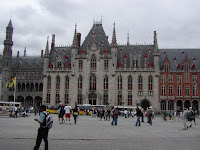
We had dinner at a local pub with delicious food and beer that seemed to evidence the Belgians’ assertion that their beer is better than Germany’s, and then it was time for a nighttime walk through the town, which had become surprisingly quiet. The water reflected the subtle lights and our footsteps echoed in the narrow alleys as we whiled away the last hours of our trip.

Taking the taxi to the train station that would take us to Brussels and a flight home the next morning, we passed through the city as it was waking up. The sun rose higher above canals and buildings that can only be described as quaint. At that moment, I felt like Bruges was begging me to stay. I had to settle for promising myself a return trip at some point.

Saturday, July 19, 2008

A State Ablaze

California is currently awash in fires, mostly started by lightning strikes from dry thunder storms. Yesterday, I was able to see some of the fires from the air, as I returned from a family reunion in Kansas and Missouri.

For weeks, those of us who live remotely near any of the fires currently raging throughout the state have woken, day after day, to smoke-filled skies and an angry red sun that seems to be frustrated by its inability to penetrate the haze.

The pouring rain I flew away from in Kansas City would have been a welcome presence in the forested areas of California, but we're not so lucky.

As the plane entered the Golden State, I looked out the window to see great clouds of smoke obscuring the usually proud mountaintops. I mi
ght have mistaken the smoke for fog were it not for an ethereal red-orange glow emanating from within.

I stared at the glowing patches of fires too remote to bother fighting as they slowly passed under the wing. I grabbed my camera too late to catch the eerie effects of the flames, but I got a few shots of the fires sending smoke toward Nevada.

I've lost track of how many fires are currently burning, but I think it's somewhere around 300. The smoke continues to hang in the valley, making for foul air, but fantastic sunsets and a blood-red moon.


Friday, July 11, 2008

The Hounds of Cheverny

France's Loire Valley is home to some of the most magnificent buildings in the world. One of the most interesting is the Château de Cheverny. Originally a fortified castle, the present building shows no signs of military architecture. As France became more stabilized after the 30 Years War, nobles tended to focus more on opulence than security.

The current château was built in the style of Louis XIII, and features symmetrical architecture, with lavishly decorated rooms, the obligatory suits of armor, and, of course, 70-odd hunting dogs which battle for a meal every day.

La soupe des chiens - the feeding of the dogs - is one of the more entertaining sights I have seen. As the time for the feeding drew near, I joined the huddle of tourists at the dog pen, enclosed by sturdy iron bars and a gate at the base of a ramp to a secondary enclosure.


The dogs knew what was happening. A few of the more eager ones ran laps in front of the assembled tourists, while others didn't seem to want to get their hopes up just yet. When a man in a blue lab coat carrying a whip came out, followed by two others who started to hose off the ground of the otherwise-empty enclosure, the dogs went nuts. They barked, bayed and howled as they jumped and pushed against each other to get close to the gate.

After hosing the ground clean, the two men opened an old wood door and began shoveling out the feast the dogs were about to consume. A layer of meat was covered by shovels full of standard dog food. The pile looked like someone had dumped a trough out and left all the food.

"Release the hounds!" the labcoated trainer called. (OK, so I don't know what the exact French words were, but that's what I imagined he said).

One of the assistants opened the gate, and a flood of canines charged through the opening, the only thing between them and the food being a few yards of wet ground.

Then they stopped when the trainer flicked his wrist. Every single one of them stood a foot or so back from the food. They whined and jostled for position, awaiting the trainer's command. Some even tried to climb on the backs of those in front. Once the trainer determined there had been sufficient anticipation, he gave a sharp command and stepped out of the way.

As one, the hounds leaped, charged, dove and scrambled for the feast. Some dug in only to be jumped on and pushed aside by others. Wagging tails waved in the air as the food was devoured faster than any of us watching probably imagined it could be.

It was over in a couple of minutes. A few scattered pieces of food lay at the far reaches of the pen before the dogs sniffed them out and ate them. Several of the hounds were cut and bloodied from the fray.

I started to walk away, then turned around and watched them a while longer. I wondered what the point was. Yes, the dogs were well-trained, and that was impressive, but other than it being a spectacle for tourists, I couldn't imagine a practical purpose for keeping them all from the food. Then again, I don't hunt, and I imagine keeping your dogs from tearing your food to ribbons is probably a concern.

The whole spectacle fit in perfectly with the surroundings. Standing on immaculately tended lawns looking at a building that served a nobleman as a palace, it makes sense that there should be an army of hunting dogs on the grounds. After all, the nobility of all European nations loved to hunt, and la soupe des chiens is an interesting way to bring the past to life.